
It's easy to start your application.
Graduate Programs
Frequently Asked Questions - PhD students
What is the typical educational background of a student admitted into the Computer Science or Computer Engineering PhD program?
Most students come in with either a bachelor's degree in computer science or engineering or a related STEM field, such as electrical engineering. A significant minority have a master's degree, but this is not required or expected. Doing a master's degree can help students get exposure to research and graduate-level courses but it does not necessarily accelerate the time to completion of the PhD.
What can I do with a PhD in CSE?
Students who graduate with a PhD in Computer Science or Computer Engineering have a wide range of options for future careers.
- Becoming a professor of computer science at a research university.
- Becoming a professor of computer science at a college that focuses primarily on teaching.
- Becoming a leader in the research labs of a large company, such as Google, Facebook or Microsoft.
- Becoming a leader in research and/or development at a medium-sized company.
- Becoming a leader at a small or startup company.
Regardless of the career they choose, PhDs are typically well paid and have quite a bit of freedom in how they carry out their work. PhDs often take on leadership roles and the jobs available to them are often more interesting, varied, and independent than the jobs held by those with a terminal Bachelor's or Master's degree.
Why should I choose to study at WashU?
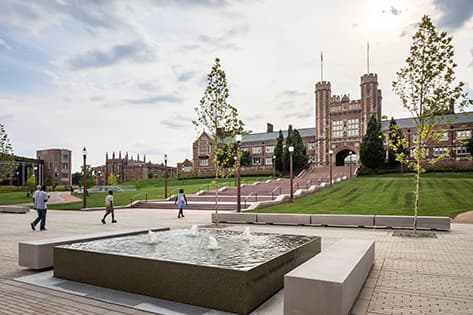
Washington University is a prestigious, world-renowned private university. St. Louis is a city with a low cost of living and a high quality of life (many students and faculty have a short, pleasant walk to school). However, it is big enough to be cosmopolitan and to offer many cultural, dining, and entertainment opportunities.
On the research front, the CSE department is friendly, collaborative, and has many faculty with active, exciting research programs and opportunities for graduate students. We are large enough to offer a wide-range of research areas, yet small enough that students know each other and most faculty, which makes for an interactive and collegial environment. This supportive environment allows our students to publish in the top venues in their field and to secure highly competitive positions upon graduation, be it in academia or industry.
How long does it take to earn a PhD?
While there is no fixed time to complete a PhD, most students finish in approximately five years.
How do I choose a lab/professor to work with?
It is recommended that you review some key pages on our website for understanding the reserach areas of our faculty members including the faculty directory page and the research area sub-pages. Since our program's admission process is a direct-admit process, it is encouraged that you reach out to faculty members whose labs you are potentially interested in joining. While it is not a formal requirement for the application process, it is beneficial to start those conversations early. You may not hear back immediately from faculty members, as they recieve many of these requests, and many faculty members wait until the application deadline has passed in a given cycle to then review the overall pool of applicants, and they then will begin contacting applicants they are interested in interviewing. After you are admitted into the program, you will receive the formal notice of what lab you have been matched with.
Once an advising relationship is finalized, students become a full member of the lab they have joined with their advisor now responsible for their financial support. However, the department guarantees continued financial support of all PhD students who remain in good standing, independent of their adviser's ability to continue supporting them.
How do I find housing?
There are a number of resources offered by the Graduate School in regard to housing, transportation and support for both domestic and international students. All students have access to a free UPass which provides free, unlimited rides on the St. Louis metropolitan region’s public transit system. The University assists graduate students with finding suitable off-campus housing through quadrangle.wustl.edu.
Is St. Louis safe?
Overall, St. Louis is a safe city, with crime rates that are typical of medium-sized U.S. metropolitan regions. St. Louis, like other major cities, faces social disparities and inequities, and some neighborhoods are safer than others. WashU is committed to promoting systemic change and keeping students safe.
The CSE department is centrally located on WashU’s Danforth Campus. Adjacent to campus you’ll discover a rich cultural life that supports your time outside of the classroom: the coffee shops and music venues of the Delmar Loop, as well as the museums and trails of nearby Forest Park, voted “Best City Park” by USA Today. The campus is served by several MetroLink light rail stations and bus lines, making the area easy to navigate. Go to police.wustl.edu for statistics and information recommended for safety precautions. Learn more about St. Louis.
What is the amount of time required weekly for research?
Students are expected to commit 40 hours/week towards the program. This includes time for both academic coursework as well as research.
Will I have time to have a social life?
You will have as much time for a social life as you would in any other full-time job.
What does it mean to be “fully-funded”?
We provide monetary support for living expenses and tuition. This stipend is adjusted each year for living expenses.
Will I be able to obtain outside scholarships?
Yes. Information on the various outside scholarships and how to apply for them is available at provost.wustl.edu/vpge/fellowships-funding-and-support/
Are there resources on campus that support PhD students?
Yes, Habif Health and Wellness offers medical and mental health services for graduate students. The Graduate Center offers a variety of clubs, seminars and workshops specifically geared toward graduate students. AGES is the Association of Graduate Engineering Students and all McKelvey Engineering PhD students are members. AGES offers networking and social events. In addition, the McKelvey Office of Graduate Programs offers support for PhD students for a variety of issues.
Can I contact a graduate student with questions?
Yes, you can connect with a Graduate student ambassador.